
Last Updated: November 3, 2026
Quick Summary
Currency risk in Indian land investment is the danger that exchange-rate movements between the rupee and your home currency reduce what you keep when returns are converted back. A 12% rupee gain can compress to roughly 2% in home-currency terms if the rupee weakens 10% over the same period. Track currency-adjusted returns, not headline rupee returns.
- Transaction, translation and economic risk are three distinct exposures, each needing a different response.
- A weaker rupee helps while you fund an investment but hurts once you harvest returns.
- The exchange rate you receive is set at conversion, not at the moment of sale.
- Staged conversion suits large lump sums; forwards work only for known exit dates.
- Red sandalwood has no interim income, so currency exposure collapses into a single repatriation event.
Table of Contents
- How Currency Risk Works in Indian Land Investment
- The Impact of Rupee Depreciation on NRI Wealth
- Repatriating Capital From Indian Land Sales
- Currency Risk Versus Land Liquidity and Valuation Risk
- Long-Term ROI of Red Sandalwood Farmland
- Hedging Currency Exposure as an Individual Property Investor
- Download the NRI Guide Before You Commit Capital
- Frequently Asked Questions
How Currency Risk Works in Indian Land Investment
Currency risk in Indian land investment is the danger that exchange-rate movements between the rupee and your home currency will reduce what you actually keep when returns are converted back. According to Cambridge research on currency risk in property portfolios, property investors have historically treated this exposure as an afterthought, even though it directly shapes realized returns. A common pattern is that an NRI buys farmland in India, sees the asset appreciate in rupee terms, and then finds the dollar or dirham outcome is smaller than expected. Below, we break down exactly how that happens, how to measure it, and what levers exist to manage it.
The Three Types of Currency Risk NRIs Face
Most guides treat currency risk as one thing. It isn't. We group it into three distinct exposures, and each needs a different response.
- Transaction risk: the rate moves between the day you commit funds and the day the money lands. A delayed wire or a slow registration process can quietly cost you.
- Translation risk: your asset gains value in rupees, but the gain shrinks when converted to your home currency. This is the exposure most NRI landowners underestimate.
- Economic risk: long-run shifts in the rupee's purchasing power alter the real value of rental income, sale proceeds, and future timber payouts.
How Exchange Rates Change Your Realized Returns
Here is the arithmetic that matters. Suppose you invest an amount that grows 12% in rupee terms over a holding period. If the rupee weakens 10% against your home currency over that same period, your home-currency return compresses to roughly 2% before costs. A stronger rupee does the reverse and amplifies your gain.
That is why currency-adjusted returns, not headline rupee returns, are the only numbers worth tracking.
The Impact of Rupee Depreciation on NRI Wealth
Rupee depreciation cuts both ways, and the honest answer is that it depends on your position in the asset's life cycle. While you are still funding an investment, a weaker rupee is a tailwind: each dollar or dirham buys more rupees, so your capital goes further. Once you are harvesting returns, a weaker rupee is a headwind: every rupee of sale proceeds or timber payout converts into fewer dollars.
For long-horizon holders, the practical implication is to think in phases. Accumulation years benefit from rupee softness. Exit years do not. Investors who never model this asymmetry are the ones surprised at the end.
Repatriating Capital From Indian Land Sales
Getting money out is where currency risk and paperwork collide. Sale proceeds must move through authorized banking channels, and the exchange rate you receive is set at the moment of conversion, not the moment of sale. A slow repatriation process leaves you exposed to rate movement you did not choose.
The rules depend on your investor status. For non-resident Indians and foreign investors, the Foreign Exchange Management Act (FEMA) and the Reserve Bank of India set the permitted funding routes, documentation, and repatriation limits. The practical sequence looks like this:
- Confirm your sale documentation and ownership records are complete before listing. Title defects are the most common cause of delayed repatriation.
- Route proceeds through the correct banking channel for your investor status. Non-resident Indians generally use NRE or NRO accounts, and the account type can affect what you can repatriate.
- Decide the conversion timing deliberately rather than accepting whatever rate lands on the day. Some banks allow you to hold proceeds in a foreign-currency account temporarily, which gives you a window to convert at a better rate.
- Keep records of every step for future compliance. Confirm with your bank and a qualified tax advisor which tax clearance and reporting documents apply before remittance.
Watch out: repatriation eligibility, permitted funding routes, documentation, taxes, and limits can depend on your investor status and the specific transaction details, and the rules change. Confirm current requirements with the Reserve Bank of India, your bank, and a qualified tax advisor before you commit capital.
For the full procedural walkthrough, see our guide on repatriating capital from Indian land sales.
Currency Risk Versus Land Liquidity and Valuation Risk
Currency exposure is not the only risk in the stack, and treating it as the headline problem can distract from bigger ones. Land is illiquid. A plot can take months or longer to sell, and the price you achieve depends on local demand at that moment. Valuation risk sits alongside it: what a parcel is worth in theory and what a buyer will pay in practice are different numbers.
Currency risk, by contrast, is continuous and measurable daily. That makes it feel more urgent than it is. Our view: manage currency deliberately, but never let it crowd out liquidity planning and honest valuation work. Property-market risk and foreign-exchange risk should be modeled together, not separately.
Long-Term ROI of Red Sandalwood Farmland
Red sandalwood farmland appeals to long-horizon investors because the return driver is biological growth plus timber value, not rental yield. That structure changes the currency math. There is no interim income stream to convert, so the entire currency question collapses into a single event: the rate on the day timber proceeds are realized and repatriated.
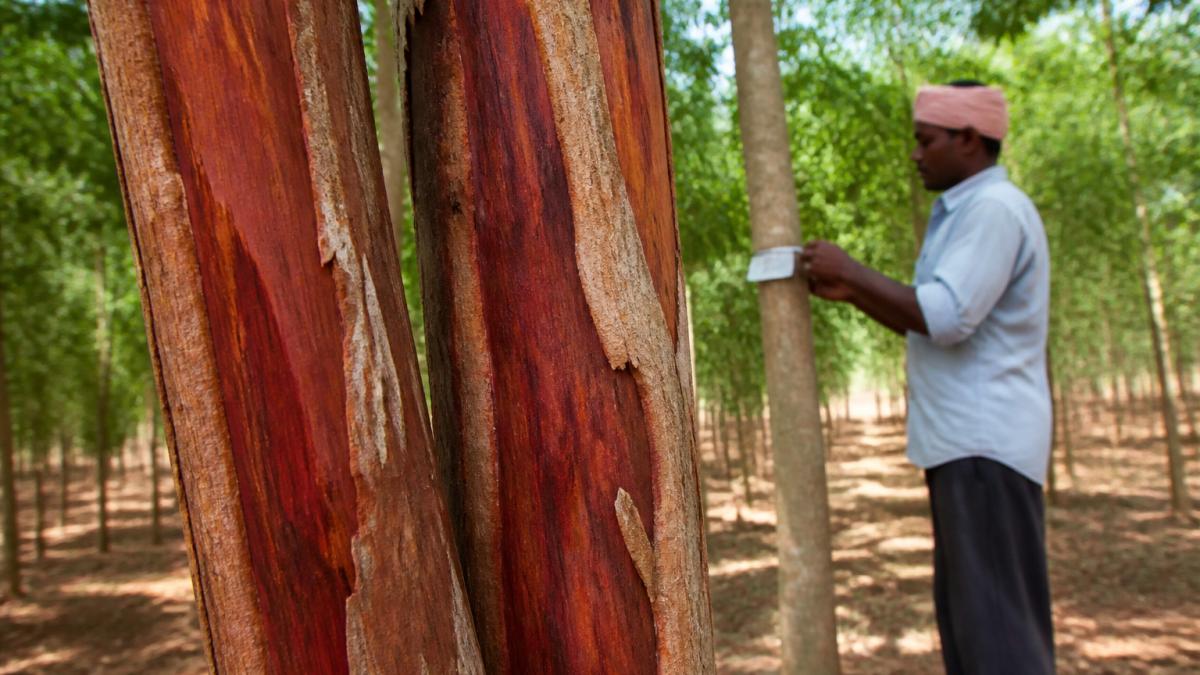
Maturation timelines are long, so the holding period spans many rate cycles. That cuts both ways: it averages out short-term volatility, but it also means you cannot time your exit around a favorable rate with precision. Understanding the maturation schedule is essential before you model any return, and our breakdown of how long red sandalwood takes to mature covers the timeline in detail.
Why Rising Red Sandalwood Demand Supports the Case
Red sandalwood's value rests on scarcity and restricted supply. The heartwood's deep red color is the commercial point: it is what buyers pay for, and it is why mature, well-managed trees command attention. Red sandalwood's value rests on scarcity and restricted supply, which is the core argument for long-term holders.
We are direct about the caveat. Demand forecasts are not guarantees, and regulatory restrictions on harvest and transport shape what you can legally sell. Anyone promising a fixed price at maturity is overselling.
Hedging Currency Exposure as an Individual Property Investor
Individual investors have fewer hedging tools than institutions, but the options are real. The Cambridge Real Estate Research Centre's work on hedging instruments describes forwards, swaps, and options as the standard instruments in property portfolios. For land investors, the practical question is which of these you can actually access, at what cost, and over what time horizon.
| Approach | What It Does | Best For | Main Drawback |
|---|---|---|---|
| Forward contract | Locks a future exchange rate | Known exit dates | Commits you to a rate; counterparty credit risk |
| Currency option | Sets a floor, keeps upside | Uncertain timing | Premium cost; limited access for individuals |
| Natural hedge | Borrow in local currency | Used buyers | Requires local credit and collateral |
| Staged conversion | Spreads conversion over time | Large lump sums | No hard protection; averages the rate |
| Remain unhedged | Accept full exposure | Long horizons with diversified currency needs | Full downside risk |
Access matters. Most individual investors cannot easily trade currency forwards or options directly; banks and brokers typically require minimum transaction sizes and credit arrangements. A common pattern is that the smallest land investors rely on natural hedges and staged conversion, while larger investors use forwards for known exit dates.
Time horizon changes the calculus. A forward contract for a land sale that may take months or years to close is impractical because you cannot commit to a date. Staged conversion works better for lump sums you can move in tranches. Remaining unhedged can be rational if your spending currency is diversified or your horizon is long enough to average out rate cycles.
Watch out: derivatives carry credit risk and interest-rate exposure of their own, and WisdomTree's analysis of currency hedging is blunt that hedging is not risk-free. For NRIs, the structure of any hedge must also fit within FEMA guidelines for NRI land investment, which constrain how funds move.
Download the NRI Guide Before You Commit Capital
Currency risk is manageable, but only if you plan for it before you commit, not after. The investors who fare best are the ones who model the rupee outcome alongside the home-currency outcome from day one, then structure their entry and exit around that reality.
If you want the full picture on managed red sandalwood farmland, including the documentation, the 60/40 timber yield share at maturity, and the compliance framework behind every unit, request the NRI Investment & Legacy Guide. When you are ready to see the plantation for yourself, contact our team to arrange a farm visit.
Frequently Asked Questions
How does rupee depreciation affect the value of my Indian land investment?
Rupee depreciation cuts your home-currency return when you convert sale proceeds. If your land gains 8% in rupees but the rupee falls 4% against the dollar over the same period, your dollar return is roughly 4%, before costs. The reverse also holds: a stronger rupee adds to your return. Because land is a long-term asset, small annual moves compound into large differences over a 10 to 15 year hold, which is why currency risk belongs in your return math from day one.
What rules apply to repatriating capital from Indian land sales?
Repatriation depends on how you funded the purchase and your residency status. Non-resident Indians who bought land with foreign exchange remitted through banking channels can generally repatriate sale proceeds, subject to documentation and limits set under India's foreign exchange rules. Sales proceeds from inherited agricultural land may follow different conditions, so confirm with official sources. Keep every remittance receipt, sale deed, and tax clearance certificate, because the paper trail is what makes repatriation straightforward rather than a prolonged review.
Can I hedge currency risk when investing in Indian farmland?
Individual investors have limited practical hedging options for illiquid land. Forward contracts, currency swaps, and options exist, but they work best for known cash flows with fixed dates. Land pays out at an uncertain future date, so a rolling hedge becomes expensive and imprecise. Most NRIs manage currency risk through diversification across currencies, matching rupee liabilities with rupee income, and choosing assets with returns high enough to absorb exchange-rate swings rather than trying to neutralize the exposure entirely.
Is red sandalwood farmland a reasonable way to offset currency risk?
A rupee decline does not automatically reduce the dollar value of the timber itself, so the asset can partly offset currency drag if harvest values rise. That said, timber prices carry their own risk, and maturity timelines are long. Treat the long-term ROI of red sandalwood farmland as one component of a diversified portfolio, not a guaranteed hedge against exchange-rate movements.
The challenge is not picking a plot. It is building a position that survives a decade of exchange-rate movement without losing its logic. RedGoldAgro structures each unit around registered patta land, Forest Department-tagged trees, and full documentation for future repatriation, so the currency question has a clean answer at exit. Get started with RedGoldAgro and build a long-horizon farmland position with the paperwork to match.
Download NRI Guide Add redgoldagro.com as a preferred source on Google →