Last Updated: November 4, 2026
Quick Summary
Andhra Pradesh farmland can be worth it for NRIs and OCIs who verify title, water access and exit terms before buying, since the state's cultivable land and canal irrigation belts keep drawing remote buyers. Registered patta land, tagged trees and FEMA-compliant ownership make managed red sandalwood plots in Kanigiri a hands-off option.
- A SAGE Journals study traced Andhra Pradesh agricultural land shifting from subsistence asset to traded asset between 2001 and 2017.
- Verify registered patta deed, encumbrance certificate, survey number and Forest Department records before any money moves.
- RedGoldAgro's Kanigiri units use SRO Patta land e-Stamp registration with each of 104 trees tagged and logged.
- Managed farmland keeps the deed in your name while a professional team handles irrigation, security and records.
- RedGoldAgro's structure provides a 60% timber yield share to the investor at maturity.
Table of Contents
- 1. Why Andhra Pradesh Farmland Draws NRI Capital
- 2. Red Sandalwood Market Demand Forecast: What Buyers Should Expect
- 3. Legal Documentation for Agricultural Land: The NRI Checklist
- 4. Managed Farmland Maintenance Costs and What They Cover
- 5. Direct Ownership vs. Managed Farmland vs. Agricultural Business
- 6. Water Security, Climate Risk, and Exit Routes
- 7. Download the NRI Guide Before You Commit
- Frequently Asked Questions
1. Why Andhra Pradesh Farmland Draws NRI Capital
Investment in Andhra Pradesh farmland has moved from a quiet family matter to a structured asset class for non-resident Indians. The state's cultivable land, canal irrigation belts, and relatively affordable acreage keep drawing buyers who want a tangible holding outside the United States. A SAGE Journals study on farmland commodification in Andhra Pradesh traced how agricultural land in the state shifted from a subsistence asset into a traded one between 2001 and 2017.
Buyers considering Andhra Pradesh farmland often are not farmers. They typically want documented ownership, a professional manager on the ground, and a clear exit route.
The catch: land title, buyer eligibility, and water access decide whether a parcel is an asset or a liability.
2. Red Sandalwood Market Demand Forecast: What Buyers Should Expect
Red sandalwood demand rests on a simple constraint: the tree is slow-growing, legally protected, and tightly regulated, so supply cannot respond quickly to price signals. That scarcity is the core of the investment case.
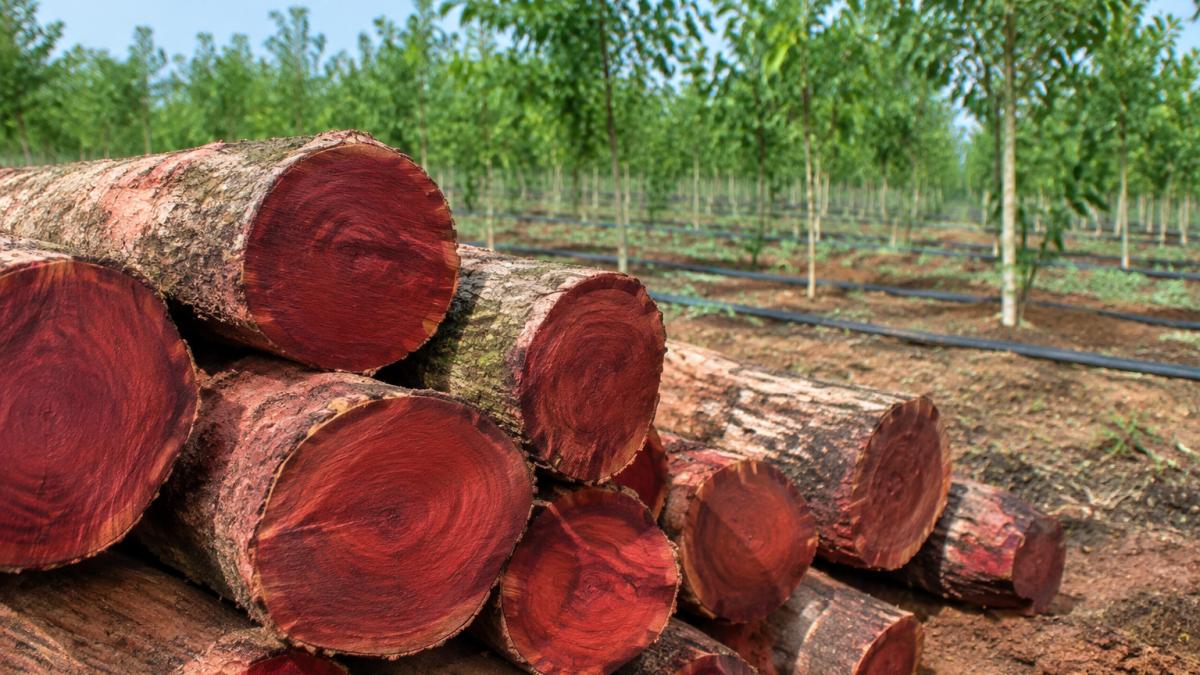
A Photo Record: Why the Red Heartwood Matters
Red is the whole point. The deep crimson heartwood is the part of the tree that carries commercial value, and it only develops as the tree matures. Buyers should ask for dated photographs of a project's standing trees and harvested heartwood, not brochure renders. A photographic record across several years is the closest a remote investor gets to seeing the asset.
Precise future prices for red sandalwood are difficult to source. Regulated supply and long maturation cycles are the factors to watch, and any precise future price quote should be treated with caution.
3. Legal Documentation for Agricultural Land: The NRI Checklist
Legal documentation for agricultural land is the step where most remote purchases succeed or fail. Verify these before any money moves:
- Registered patta land deed in the seller's name
- Encumbrance certificate covering the full ownership history
- Survey number matching the physical boundaries on the ground
- Forest Department records for any sandalwood standing on the plot
- e-Stamp registration completed at the Sub-Registrar Office
- Repatriation paperwork confirmed before purchase, not after
RedGoldAgro's units are registered through direct SRO Kanigiri Patta land e-Stamp registration, with each of the 104 trees tagged and logged with the Forest Department. If you want the deeper walkthrough, read how to verify Indian agricultural land deeds.
FEMA Rules and Buyer Eligibility for Non-Residents
Non-resident Indians and OCI holders can hold agricultural land in India under the foreign exchange framework, but the paperwork has to be right from day one. Buyer eligibility, permitted holding structures, and repatriation rules all sit under FEMA. RedGoldAgro's process is built around legal FEMA compliance for NRI ownership, and we recommend reading how to follow FEMA guidelines for NRI land investment before you sign anything.
4. Managed Farmland Maintenance Costs and What They Cover
Managed farmland maintenance costs cover the work a remote owner cannot do: irrigation, security, labor, and record-keeping. Pricing depends on plot size, tree count, and the scope of management. Request a quote from RedGoldAgro for current pricing.
What a management agreement should spell out:
- Drip irrigation scheduling and water sourcing
- 24/7 security and encroachment response
- Tree tagging, logging, and Forest Department coordination
- Harvest, transport, and yield accounting at maturity
Read the contract for what happens when a tree dies or a boundary is disputed. That clause matters more than the monthly number.
5. Direct Ownership vs. Managed Farmland vs. Agricultural Business
Three routes exist, and they suit different buyers. Direct ownership gives you the deed but puts every operational decision on you from 8,000 miles away. Managed farmland keeps the deed in your name while a professional team runs the property. An agricultural business means equity in an operating venture, with the returns and the risks that come with it.
| Route | Control | Day-to-Day Work | Best For |
|---|---|---|---|
| Direct ownership | Full | High | Buyers living locally |
| Managed farmland | Ownership retained | Handled by manager | Remote NRIs and OCIs |
| Agricultural business | Shared | Varies | Investors wanting operating exposure |
Managed farmland pairs registered ownership with a hands-off model. RedGoldAgro's structure provides a 60% timber yield share to the investor at maturity.
6. Water Security, Climate Risk, and Exit Routes
Canal irrigation and groundwater are important factors in long-term yield. A 2024 Cambridge University Press study on land ownership and farm investment risk examined how ownership security shapes investment risk in Indian agriculture, and the takeaway for buyers is that a clean title does not remove operational risk.
Check the water source, the recharge record, and the drought history of the district before you buy.
On exit, ask two questions: can you sell the unit before maturity, and who buys it? A resale market needs documented units and a manager willing to support a transfer. We explain the process in our guide on how to sell managed farmland units.
7. Download the NRI Guide Before You Commit
The gap between a good farmland purchase and a costly one is documentation. Red sandalwood takes years to mature, and the buyers who do well are the ones who verified title, water, and exit terms before signing. If you are weighing the timeline, read how long red sandalwood takes to mature first.
RedGoldAgro offers fully managed red sandalwood farmland in Kanigiri, with registered patta land, tagged trees, drip irrigation, and 24/7 security. Request the NRI Investment & Legacy Guide and review the documentation before you decide.
Frequently Asked Questions
Is farmland a good investment now for non-resident buyers?
It depends on the structure. Direct ownership gives you title but leaves you managing water, labor, and resale from abroad. A managed unit bundles registered land with professional upkeep, which suits buyers who cannot visit. Treat land as a long-hold asset, not a liquid one, and confirm how title is registered and how yield is split before you commit.
What legal documents should I verify before buying agricultural land?
Ask for the patta land record, the registered sale deed and e-stamp, an encumbrance certificate covering a long lookback period, and a survey number that matches the physical plot. For timber crops, request proof that trees are tagged and logged with the Forest Department. Cross-check every document against the state land records portal rather than relying on a broker's photocopy. Legal documentation for agricultural land is the single strongest protection a remote buyer has.
How much does managed farmland maintenance cost, and who pays it?
Managed farmland maintenance costs typically cover drip irrigation, security, labor, and crop care, and they are usually quoted as a fee or deducted from harvest proceeds. Ask for the fee structure in writing, whether it escalates over the holding period, and what happens if you exit early. RedGoldAgro structures its model as a 60/40 timber yield share at maturity, so confirm which costs sit inside that split and which are billed separately before you sign.
What is the projected demand for Red Sandalwood in the coming years?
Red sandalwood is a restricted, slow-growing timber with steady demand from carving, furniture, and specialty buyers, and supply is capped because harvest requires government authorization. That scarcity supports long-term pricing but also means your exit depends on permits and a buyer at maturity. Ask any operator how trees are tagged and logged with the Forest Department, and treat demand forecasts as directional rather than guaranteed.
Can I repatriate the proceeds if I sell my farmland later?
Non-resident buyers can hold agricultural land under FEMA rules, but repatriation depends on how the original purchase was funded and on documented proof of sale. Keep every receipt, the e-stamp registration, and the sale deed in your own records. Confirm the process with a qualified advisor before you buy, not after, because missing documentation is what slows repatriation down.
The real test of investment in Andhra Pradesh farmland is not the pitch, it is the paperwork you can hold. Get started with RedGoldAgro and build a documented, fully managed timber asset for your family's future.
Download NRI Guide Add redgoldagro.com as a preferred source on Google →