Table of Contents
- Why Agricultural Land Investment in India Attracts NRIs
- NRI Agricultural Land Purchase Rules India: FEMA, Patta, and Eligibility
- Agricultural Land Due Diligence Checklist India: Title, Encumbrance, and Survey
- Managed Farmland Investment India: How the Hands-Off Model Works
- Red Sandalwood Maturity Period and Demand: What the Next Decade Holds
- Risk-Adjusted Returns and Exit Liquidity for Agricultural Land
- Frequently Asked Questions
Last Updated: October 21, 2026
Why Agricultural Land Investment in India Attracts NRIs
Agricultural land is the asset class NRIs keep coming back to, and for good reason. It sits outside the volatility of equities, it produces something real, and it does not require daily attention. At RedGoldAgro, we work almost exclusively with overseas buyers who want exactly that: a tangible holding they can hold for decades.
The pitch is simple. Farmland is finite. Demand for timber, food, and horticulture keeps climbing. And for the diaspora, land in India carries emotional weight that a brokerage account never will.
But here is the tension most guides skip: the safest agricultural land investment in India is not the cheapest plot or the fastest-yielding crop. It is the one where the paperwork survives scrutiny and the water does not run out.
Everything below builds on that single idea.
- Capital security comes from clean title, not from a glossy brochure
- Appreciation follows infrastructure and water, not hype
- Income depends on crop choice and management, not wishful thinking
NRI Agricultural Land Purchase Rules India: FEMA, Patta, and Eligibility
The short answer: NRIs and OCIs may buy agricultural land in India, but only with the right approvals and only under specific conditions. FEMA rules govern the money flow. State land laws govern who can hold the title. Both must line up.
FEMA is the Foreign Exchange Management Act. It controls how money moves across the border, and it dictates how you bring funds in and how you take proceeds out. For agricultural land, the rules are stricter than for residential property. You cannot simply wire money and register a deed. Funds must come through proper banking channels, and the purchase must be reported correctly. Repatriation of sale proceeds is possible, but only if the original acquisition complied with FEMA, a defect at purchase can trap your capital for years.
Patta is the revenue record that proves the government recognizes you as the landholder. A patta in your name, with matching survey numbers, is the backbone of legal ownership. In many states the patta is not the same as the registered sale deed; you need both, and they must agree.
Before you commit, confirm these points:
- Funds routed through proper banking channels with a clear paper trail
- Patta registered in your name at the local sub-registrar office
- Survey number cross-checked against the village land records
- Encumbrance certificate showing no outstanding claims
- Seller's title chain verified back several generations
- State-specific ceiling and eligibility rules confirmed
- Land use and conversion restrictions checked if you plan non-farm use
- Power of attorney, if used, drafted and notarized to local standards
State land laws vary widely, and this is where most generic guides stop. Some states restrict agricultural purchase to farmers or agriculturists. Others allow NRIs with conditions, and a few require prior permission from the state revenue department. Land ceiling acts cap how much agricultural land a single holder can own, and those caps differ by state and by land class. Conversion rules, what it takes to shift land from agricultural to non-agricultural use, are a separate layer again.
Because the rules are state-specific and change, treat any national summary as a starting point only. Before signing anything, confirm the current position with a property lawyer who practices in that state, and ask specifically about: who is eligible to hold agricultural land, whether NRI purchase needs prior approval, the applicable ceiling, and any restriction on conversion or transfer. A short written opinion from local counsel is cheap insurance against a title that cannot be regularized later.
Agricultural Land Due Diligence Checklist India: Title, Encumbrance, and Survey
Due diligence is where the safest agricultural land investment in India is actually won or lost. Most disputes trace back to skipped verification, not bad luck.
Here is how we would run it:
- Pull the encumbrance certificate for the past 30 years. It lists every registered transaction and mortgage on the property.
- Match the survey number against the village map and the patta. A mismatch is a red flag, not a clerical error.
- Check mutation records to confirm ownership changes were officially logged.
- Verify the seller's identity and their right to sell. Heirs and joint owners must all sign.
- Walk the physical boundaries with a local surveyor. Encroachment is common and quiet.
- Confirm zoning and land conversion status if you plan non-agricultural use.
A clean title chain, a current encumbrance certificate, and a surveyor's report are non-negotiable. Skip one and you inherit someone else's problem.
Pro Tip Request the encumbrance certificate directly from the sub-registrar rather than accepting a copy from the seller. It costs little and closes the biggest gap in most deals.Managed Farmland Investment India: How the Hands-Off Model Works
Managed farmland investment in India solves a specific problem: you cannot run a farm from another continent. The model bundles land ownership with professional management, so you hold the title while someone else handles the trees.
At RedGoldAgro, each unit includes 1,066 square yards of registered patta land and 104 Red Sandalwood trees. Drip irrigation, 24/7 security, and legal compliance are handled by the management team. At maturity, investors receive a 60% share of the timber yield.
That structure appeals to busy professionals for a few reasons:
- You own registered land, not a paper promise
- Trees are tagged and logged with the Forest Department
- Maintenance and security are off your plate
- Documentation supports future repatriation
But managed does not mean blind. Ask for the patta deed, the tree tagging records, and the Forest Department logs before you invest. A legitimate operator will hand them over without hesitation.
Red Sandalwood Maturity Period and Demand: What the Next Decade Holds
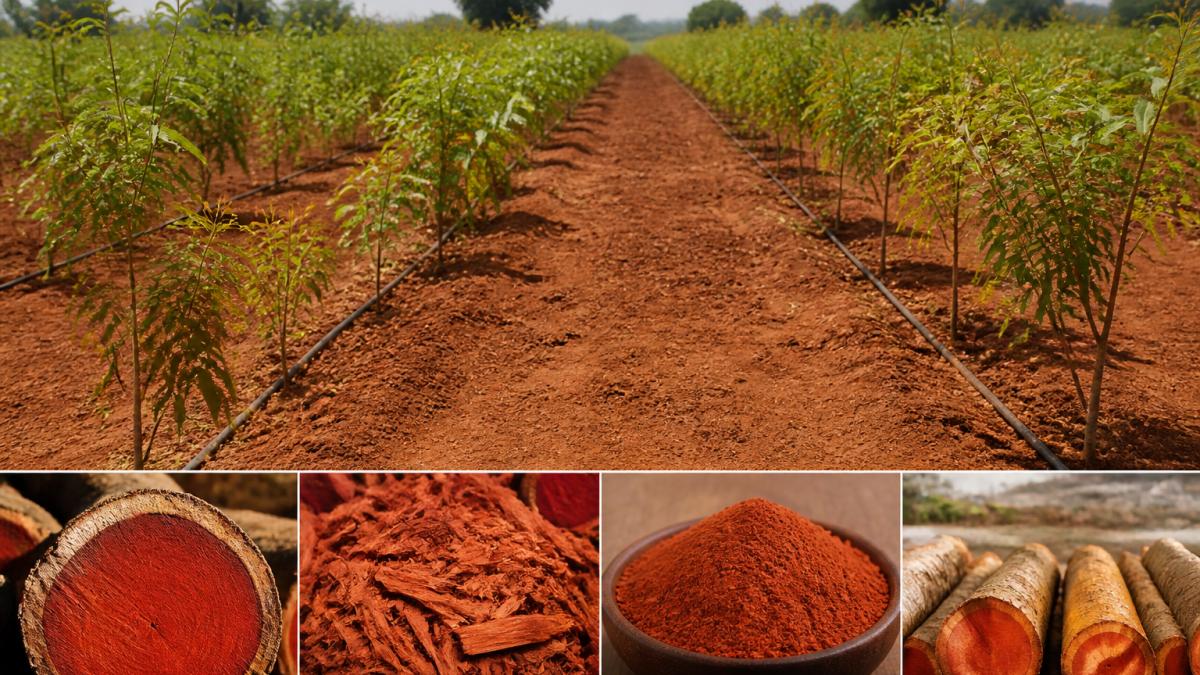
Red sandalwood takes time. Trees mature over roughly 15 to 20 years, and the heartwood deepens in color as they age. That long horizon is exactly why the asset rewards patience, and why the red color matters so much.

The color is the product. Red sandalwood is prized for its deep red heartwood, used in furniture, carvings, and traditional crafts. The richest red comes from older heartwood, which is why maturity period and value are linked: a tree cut too early yields paler wood and a lower grade. Buyers who understand this grade the timber by color and density, not just by weight.
Demand is the other half of the story. Supply is tightly controlled because the species is protected, which limits how much legal timber reaches the market. That combination, slow supply and steady demand, is what makes the next decade interesting. Restrictions on harvesting and trade keep legal supply scarce, and enforcement against illegal trade tightens the premium on verified, legally sourced timber.
Looking ahead, several forces point the same direction. Craft and furniture demand for naturally red heartwood remains steady, and the pool of legally documented mature timber is limited by the long growth cycle. Buyers who hold verified, legally sourced timber stand to benefit most. At the same time, price forecasts for any timber are uncertain. Treat projections as scenarios, not guarantees, and size your position accordingly.
Pro Tip When you visit a plantation, ask to see a freshly cut stump or a trimmed log. The red heartwood should be vivid and consistent. Pale or streaked wood signals early harvest or poor genetics, a quality issue that shows up in price at maturity.A word of caution: price forecasts for any timber are uncertain. Treat projections as scenarios, not guarantees, and size your position accordingly.
Risk-Adjusted Returns and Exit Liquidity for Agricultural Land
Returns on farmland look attractive until you subtract the costs. A realistic view includes maintenance, security, irrigation, taxes, and the years before any income arrives. Net return is what matters, not the headline number.
Liquidity deserves equal attention. Agricultural land does not sell overnight. Resale can take months, and the buyer pool is smaller than for residential property. Plan your investment horizon before you buy, not after.
Key Takeaway The safest agricultural land investment in India is one you can hold through a full cycle. If you might need the capital in two years, farmland is the wrong vehicle.Currency risk also matters for overseas buyers. Rupee movements can erode dollar returns. Build that into your assumptions rather than ignoring it.
Buying farmland from abroad is a test of patience and paperwork. The investors who do well are the ones who verify everything, plan for a long hold, and work with a team that handles the ground-level details. RedGoldAgro structures each holding around registered patta land, Forest Department-tagged Red Sandalwood, drip irrigation, and 24/7 security, with a 60% timber yield share at maturity and full documentation for repatriation. Download the NRI guide to see how the model works and what you will hold in hand before you commit.
Frequently Asked Questions
Can NRIs legally buy agricultural land in India?
NRIs cannot purchase agricultural land, farmhouses, or plantations directly under FEMA rules. However, they can acquire agricultural land through inheritance or receive it as a gift from a resident. OCIs face the same restrictions. To gain exposure, many NRIs choose managed farmland structures where a resident entity holds the land and the NRI invests in the harvest or a registered unit. Always confirm the structure with a local legal advisor and check state-specific rules before committing funds.
What documents should I verify before buying agricultural land in India?
Use an agricultural land due diligence checklist India buyers rely on: the land title deed, encumbrance certificate covering at least 30 years, mutation records, survey number and boundary maps, patta or khata documents, and tax receipts. Confirm the seller's identity and authority to sell, and check for any litigation or liens. For managed farmland, also review the management agreement, tree tagging records, and Forest Department registration for red sandalwood. Independent legal verification is essential.
How long does red sandalwood take to mature for harvest?
Red sandalwood typically matures over 15 to 20 years, with heartwood developing the deep red color and density that drives value. Some managed plantations plan thinning or partial harvests earlier, but full maturity for premium timber usually falls in that range. The long maturity period and red sandalwood demand in coming years mean investors should match this asset to a long-term horizon and account for maintenance costs and yield-sharing terms before investing.
Is managed farmland a safe investment for NRIs?
Managed farmland can reduce the operational burden for NRIs, but safety depends on the provider's legal structure, transparency, and track record. Look for FEMA-compliant ownership, registered patta land, clear yield-sharing terms, and independent verification of tree counts and Forest Department logs. Ask how disputes, encroachment, and maintenance are handled. No investment is risk-free, so review the agreement with a lawyer and confirm exit options before committing capital.
Download NRI Guide