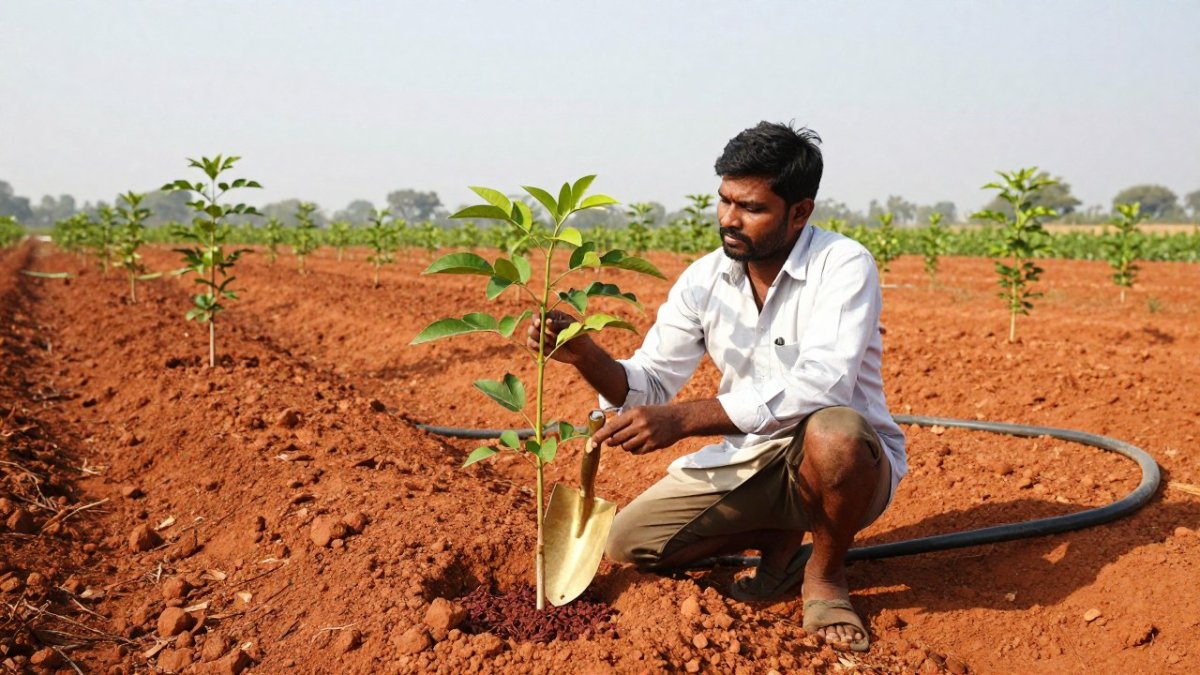
Last Updated: November 10, 2026
Quick Summary
Compare red sandalwood and teak plantations by first checking your holding horizon, since both are long-cycle crops with different timelines. Red sandalwood's value hinges on heartwood formation, which is not guaranteed by plantation age, while teak's larger market is easier to benchmark. Verify soil, host-tree needs, and documented assumptions before comparing returns.
- Teak is typically managed on 20 to 30 year rotations for sawtimber, with thinning starting around year 5 to 8.
- A 14-year-old Indian sandalwood plantation in Western Australia had 25% of trees without heartwood, a risk for red sandalwood too.
- Red sandalwood's market was valued at $2.29 billion in 2026, projected to reach $3.54 billion by 2031.
- The global teak market was estimated at $55,646.7 million in 2026, projected to reach $115,587.78 million by 2035.
- Build a non-heartwood and delay scenario into any red sandalwood return estimate before comparing it with teak.
Table of Contents
- What You Are Actually Comparing: Red Sandalwood and Teak Explained
- Step 1: Define Your Investment Horizon and Growth Timelines
- Step 2: Check Host Tree Requirements, Soil and Climate Fit
- Step 3: Review the Red Sandalwood Demand Forecast Against Teak Demand
- Step 4: Estimate Sandalwood Tree Price After 15 Years Using Documented Assumptions
- Step 5: Run Timber Plantation Investment Due Diligence
- Next Step: Request the Documentation and Plantation Calendar Before You Decide
- Frequently Asked Questions
What You Are Actually Comparing: Red Sandalwood and Teak Explained
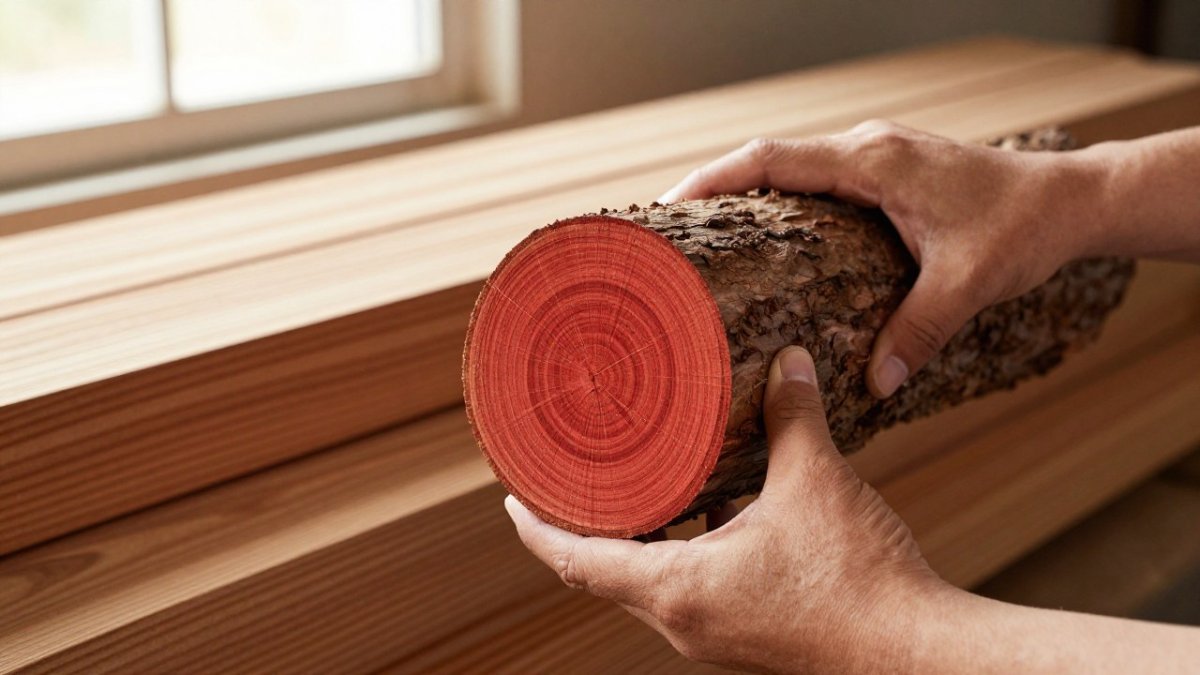
If you are weighing a red sandalwood plantation against a teak plantation, you are comparing two very different timber assets. Red sandalwood (Pterocarpus santalinus) is a slow-growing hardwood valued for its deep red heartwood. Teak (Tectona grandis) is a widely planted hardwood with a long, well-documented commercial history. The two share a plantation model but differ in species, growth habit, and market dynamics, so a fair comparison has to treat them separately.
!Close-up of hands holding a freshly cut red sandalwood log beside a stack of teak planks
Red sandalwood is commercially valued largely for its heartwood. The market context is moving: one market forecast values the red sandalwood market at $2.29 billion in 2026, projected to reach $3.54 billion by 2031, a reported compound annual growth rate of 9.08% (Mordor Intelligence red sandalwood market forecast). Market forecasts are useful context, but they do not tell you what an individual plantation will yield or return.
Teak, by contrast, has a much larger global market. A separate estimate places the global teak market at $55,646.7 million in 2026, projected to reach $115,587.78 million by 2035 (Market Reports World teak wood market research). The scale difference matters: teak's larger, more liquid market is one reason many investors treat it as a reference point.
Plantation outcomes depend on more than market size. Heartwood formation is one example. A study of a 14-year-old Indian sandalwood plantation in Western Australia found that 25% of trees did not show heartwood formation (Chavan et al. study on Indian sandalwood plantation heartwood). That study concerns Indian sandalwood, not red sandalwood, but it shows that plantation age alone does not guarantee a harvestable product.
Step 1: Define Your Investment Horizon and Growth Timelines
Start by deciding how long you can hold the asset. Both species are long-cycle timber crops, and the time to a harvestable product is the single biggest factor in any comparison. The two species do not mature on the same clock, and treating them as interchangeable on timeline is the most common planning error.
Teak is typically managed on rotations of 20 to 30 years for sawtimber, with thinning cycles that begin around year 5 to 8 and repeat every 5 to 7 years. Plantation teak grown in the tropics can reach commercial pole size earlier, but the premium sawtimber grades that drive the highest prices generally require the longer rotation. Teak's value rises with heartwood quality and grade, and grade is a function of age, site, and silviculture, not just diameter (Kadek Living teak price and grades guide).
Red sandalwood is a slow-growing species, and heartwood formation, not trunk diameter, is the gating event for harvest. A study of a 14-year-old Indian sandalwood plantation in Western Australia found that 25% of trees did not show heartwood formation at that age (Chavan et al. study on Indian sandalwood plantation heartwood). That study concerns Indian sandalwood, not red sandalwood, but it illustrates the core risk: age alone does not guarantee a harvestable heartwood product. For red sandalwood, plan on a longer holding period than teak and build in a mortality and non-heartwood allowance before you compare returns.
A practical way to compare the two is to build a year-by-year calendar for each species and line them up side by side. A typical teak calendar includes site preparation and planting in year 0, early weed control and fertilization in years 1 to 3, first thinning around years 5 to 8, subsequent thinnings every 5 to 7 years, and final harvest in years 20 to 30. A red sandalwood calendar includes site preparation and host-tree establishment in year 0, host management and pruning in years 1 to 5, ongoing protection from theft and grazing, heartwood monitoring from around year 10 onward, and harvest timing driven by heartwood assessment rather than a fixed rotation. Write down your target horizon, for example 15 or 20 years, and mark where each species falls relative to it. A plantation that matures outside your window may be a poor fit even if its eventual value is attractive.
Ask any provider to show the maturity assumptions behind its timeline, and note whether those assumptions are documented or only stated. Watch out: a timeline that depends on ideal growing conditions can run late in practice, and a red sandalwood timeline that assumes uniform heartwood formation can fail outright. Build a delay scenario and a non-heartwood scenario into your numbers before you compare anything.
Step 2: Check Host Tree Requirements, Soil and Climate Fit
Sandalwood species have specific growing needs that teak does not share. Red sandalwood depends on suitable site conditions, and research into smallholder sandalwood plantations addresses how sandalwood interacts with host trees and which varieties are suited to particular regions (ACIAR smallholder teak and sandalwood plantation project(https://www.aciar.gov.au/project/fst-2018-178)).
Online meeting - Success story of Sandal wood and Teak wood intercropping - By Jyotsna Hariharan
Agriculture Information
Before you compare returns, confirm that the land suits the species. Check soil type, rainfall, drainage, and whether the plantation provides host trees or other site support. A site that works for teak may not work for red sandalwood, and the reverse is also true.
| Factor | Red Sandalwood | Teak |
|---|---|---|
| Growth period | Long-cycle, commonly many years | Commonly decades |
| Key value driver | Heartwood quality | Heartwood and grade |
| Host requirement | Yes, host trees matter | Generally not a host-dependent crop |
| Market scale (2026 estimate) | $2.29 billion | $55,646.7 million |
Step 3: Review the Red Sandalwood Demand Forecast Against Teak Demand
Demand forecasts are where most plantation pitches get persuasive, so read them carefully. The red sandalwood forecast of $2.29 billion in 2026 and $3.54 billion by 2031, a reported compound annual growth rate of 9.08%, is a useful signal of interest in the market (Mordor Intelligence red sandalwood market forecast). But the published result does not say what geography or methodology it covers, so treat it as one input rather than a guarantee. The more useful exercise is to understand what is actually pushing red sandalwood demand in the coming years, then judge whether those drivers are durable.
Before you rely on any demand forecast, confirm the legal pathway for planting, transporting, harvesting, and selling red sandalwood in the jurisdiction where the plantation sits, and verify current rules with the relevant authority rather than a provider's summary.
Teak's demand picture is broader and better documented. A 2026 ITTO webinar reportedly compared the properties of teak from natural forests and plantations, which speaks to how buyers judge plantation-grown wood (ITTO webinar on super teak(https://www.itto.int/news/2026/10/14/super_teak_draws_record_crowd_to_itto_webinar/)). A separate estimate places the global teak market at $55,646.7 million in 2026, projected to reach $115,587.78 million by 2035 (Market Reports World teak wood market research). The scale difference matters: teak's larger, more liquid market is one reason many investors treat it as a reference point, and it also means teak prices are more transparent and easier to benchmark than red sandalwood prices.
The honest answer is that a like-for-like demand comparison is hard to find. Compare the two forecasts on the same basis: same source type, same year, same geography where possible. Be cautious about any forecast that does not show its assumptions. A forecast built on historical price trends, for example, tells you something different from one built on projected consumption growth. For the broader forecasting question, see our guide on how to evaluate red sandalwood demand forecasts.
Watch out: a headline market size figure can grow while the price for a specific grade of wood falls, because market value mixes volume and price. Ask which grade, which market, and which legal supply channel a forecast assumes before you use it to justify a plantation investment.
Step 4: Estimate Sandalwood Tree Price After 15 Years Using Documented Assumptions
Projecting a future tree price means stacking assumptions, so make each one explicit. Start with the expected harvest year, then estimate heartwood yield per tree, then apply a price per unit of wood. Each step can move the answer a long way.
Keep every input labeled and sourced. If you cannot source an input, label it as an assumption and test a range around it. Do not accept a single headline number without seeing the inputs behind it.
Current market context for wood pricing is covered in our red sandalwood wood price outlook for 2026. Use it to ground your assumptions, but remember that a 15-year price is a projection, not a current quote.
Watch out: many published price figures reflect a single grade or a narrow market. Ask which grade and which market your estimate assumes.
Step 5: Run Timber Plantation Investment Due Diligence
Due diligence is where a comparison becomes a decision. For each option, check the legal ownership structure, the documentation you will receive, how trees are identified and recorded, how the land is secured and managed, and what the exit and repatriation options look like. For a US-based investor, also confirm how any cross-border transfer and tax reporting would work with your own advisor.
Compare providers against the same checklist rather than their own marketing. Our guide on how to compare red sandalwood investment companies sets out criteria you can apply to each one. Ask every provider for independent references, and verify any registration or government documents yourself rather than relying on copies they supply.
Note the risks beyond the headline return: long time to harvest, species-specific growth risk, market price swings, and the difficulty of inspecting the land in person. A plantation that looks strong on paper can still underperform if these risks are not managed.
Next Step: Request the Documentation and Plantation Calendar Before You Decide
Before you commit to any red sandalwood or teak plantation, request the full documentation package in writing. Ask for the land ownership records, the tree registration details, the management and maintenance schedule, and a year-by-year plantation calendar. Compare every option against the same set of documents.
If you are considering RedGoldAgro, you can contact the team to request documentation and to ask about a farm visit to the Kanigiri site in Andhra Pradesh.
Frequently Asked Questions
What are the key differences between red sandalwood and teak plantations?
Teak is a large commercial hardwood with a long rotation and a well-established timber market, while red sandalwood is a smaller tree whose value depends on heartwood, which takes years to form and is not guaranteed. Teak is typically managed for timber volume; red sandalwood requires host-tree planning and careful site selection. Compare growth timelines, host requirements, and the documented evidence for each before deciding which fits your horizon and risk tolerance.
How should investors compare red sandalwood and teak plantation timelines?
Start with the expected time to harvestable timber for each species under your specific site conditions, then compare the years of management required and the cash-flow gaps before any return. A published market forecast does not show when your own trees will mature. Ask for documented growth data and a written harvest timeline for both options, and check what happens if maturity is delayed.
What should investors verify before investing in a timber plantation?
Verify land title and registration, any government documentation for trees, the terms of the yield share, the host-tree and irrigation arrangements, and who is responsible for security and maintenance. Request written evidence for any yield claim and confirm the exit terms and the repatriation process before committing funds. Treat promotional videos and marketing material as starting points, not as due-diligence sources.
 Add redgoldagro.com as a preferred source on Google →